The Agricultural Imperative: A Global Crossroads
The global food system stands at a critical juncture. With the world population projected to reach nearly 10 billion by 2050, coupled with the escalating pressures of climate change, water scarcity, and arable land depletion, the traditional models of agriculture are proving increasingly unsustainable. The challenge is not merely to produce more food, but to produce it more efficiently, more sustainably, and closer to the point of consumption. This imperative has catalyzed the rise of Controlled Environment Agriculture (CEA), and at the forefront of this revolution is Infarmight, a smart farm company pioneering the future of food production.
This analysis provides a comprehensive, side-by-side comparison of Infarmight’s innovative vertical farming model against the established practices of conventional, open-field agriculture. By examining key metrics—from resource consumption and environmental impact to technological integration and economic viability—we can better understand the transformative potential of smart farming in securing a resilient food future.
Resource Efficiency: Water and Land
The most immediate and striking difference between the two models lies in their consumption of two finite resources: water and land.
Water Usage: The Closed-Loop Advantage
Traditional farming is notoriously water-intensive, accounting for approximately 70% of global freshwater withdrawals. The reliance on open-field irrigation, whether through flood, furrow, or even more efficient drip systems, is subject to significant losses through evaporation, runoff, and percolation. This inefficiency is a major contributor to water stress in many regions.
Infarmight’s systems, by contrast, operate on a closed-loop hydroponic or aeroponic principle. Plants are fed a precisely measured, nutrient-rich water solution, and any water not absorbed by the plants is collected, filtered, sterilized, and recirculated back into the system. This process results in a staggering reduction in water consumption—often up to 95% less than traditional methods for the same crop yield. In an era of increasing droughts and unpredictable weather patterns, this level of water stewardship is not just an advantage; it is a necessity.
Land Footprint: Vertical Stacking for Maximum Yield
Conventional agriculture demands vast tracts of arable land, leading to deforestation, habitat loss, and soil degradation. The practice of monoculture further depletes soil nutrients, necessitating chemical fertilizers and fallow periods.
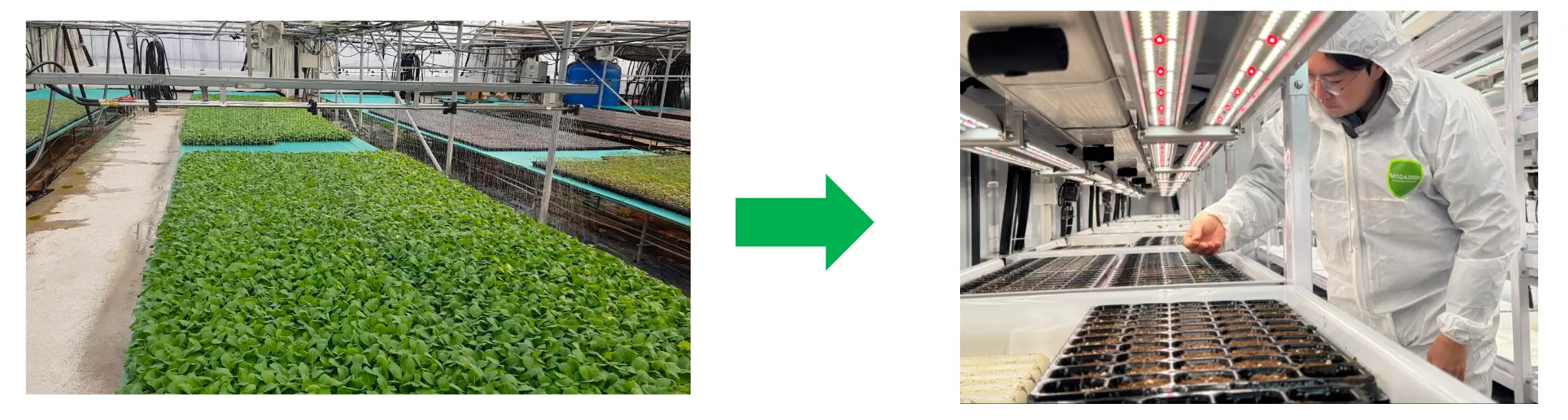
Infarmight completely redefines the concept of a farm footprint. By growing crops in vertically stacked layers within climate-controlled modules, the company achieves an unprecedented level of productivity per square meter. A single Infarmight unit can produce the equivalent yield of several acres of traditional farmland. This vertical stacking allows for the reclamation of land, the preservation of natural ecosystems, and, crucially, the ability to integrate food production directly into urban environments. The farm is no longer a distant field but a modular unit located within a city warehouse or even a grocery store.
[Image 1: Vertical farm setup]
Crop Quality and Yield Management
The environment in which a crop is grown fundamentally dictates its quality, consistency, and the predictability of its harvest.
Yield Stability and Predictability
Traditional farming is inherently susceptible to external variables—pests, diseases, unexpected frosts, hailstorms, and prolonged droughts. These factors introduce significant risk and volatility into the food supply chain, leading to unpredictable yields and fluctuating market prices.
Infarmight’s system offers complete environmental control. By isolating the crops from the external world, the system guarantees a stable, optimal climate 365 days a year. This means harvests are not only consistent but also highly predictable, allowing for precise planning and eliminating the risk of weather-related crop failure. Furthermore, the ability to grow crops year-round, regardless of local climate or season, dramatically increases the annual yield from the same physical space.
Pest Control and Chemical Independence
One of the most compelling arguments for CEA is the elimination of agrochemicals. Traditional farming relies heavily on chemical pesticides, herbicides, and fungicides to combat the constant threat of pests and weeds in an open environment. These chemicals pose risks to human health, biodiversity, and water systems.
Within Infarmight’s sealed, sterile environment, the conditions that allow pests and diseases to thrive are simply not present. This closed system means there is no need for chemical pesticides or herbicides, resulting in truly clean, residue-free produce. This is a significant health and environmental benefit that resonates strongly with modern consumers.
[Image 2: Close-up of healthy, stacked crops]

Environmental and Supply Chain Impact
The environmental cost of food production extends far beyond the farm gate, encompassing transportation, storage, and waste.
Reducing Food Miles and Carbon Footprint
The modern global food supply chain is a logistical marvel, but it comes at a high environmental cost. Produce often travels thousands of miles—known as “food miles”—from farm to consumer, requiring refrigerated transport that contributes significantly to carbon emissions.
Infarmight’s model is inherently decentralized and hyper-local. By placing farms directly within or adjacent to urban centers, the distance food travels is drastically reduced, often to mere meters. This reduction in food miles translates directly into a lower carbon footprint for the produce and ensures that the food reaching the consumer is exceptionally fresh, having been harvested hours, not weeks, before consumption.
Waste Reduction and Shelf Life
Post-harvest loss is a major global issue, with a significant portion of conventionally grown produce spoiling during transit and storage. The long, complex supply chain exacerbates this problem.
Because Infarmight’s produce is grown and distributed locally, the time between harvest and consumption is minimized. This not only preserves the nutritional integrity and flavor of the food but also dramatically reduces spoilage and waste. The shortened supply chain is a key factor in creating a more efficient and less wasteful food system.
The Role of Technology and Automation
The transition from traditional to smart farming is fundamentally a shift from manual labor and intuition to data-driven precision.
Infarmight’s Core Technology: AI and IoT
Infarmight’s farms are essentially sophisticated biological data centers. They are powered by a complex array of Internet of Things (IoT) sensors that continuously monitor every critical growth parameter: light intensity and spectrum, air temperature, humidity, CO2 levels, pH, and the precise nutrient composition of the water.
This massive stream of data is fed into a central Artificial Intelligence (AI) platform. The AI analyzes the data, compares it against optimal “growth recipes” for specific plant varieties, and automatically adjusts the environment in real-time. If a plant needs more blue light to enhance leaf growth or a slight adjustment in potassium levels, the system executes the change instantly and precisely. This level of precision agriculture is impossible to achieve in an open-field setting.
Labor and Skill Shift
While traditional farming requires extensive, often back-breaking manual labor, smart farming shifts the labor requirement from physical strength to technical expertise. Infarmight farms are largely automated, with human involvement focused on planting, harvesting, quality control, and, most importantly, the technical oversight and maintenance of the complex systems. The future of farming labor is less about a hoe and more about a data dashboard.
Economic Viability and Scalability
While the environmental and quality benefits are clear, the long-term success of any agricultural model hinges on its economic viability and ability to scale.
Capital Expenditure vs. Operational Costs
The initial investment for establishing an Infarmight vertical farm is significantly higher than acquiring and preparing a plot of traditional farmland. The cost of the infrastructure—the building, the LED lighting systems, the climate control technology, and the AI platform—represents a high capital expenditure.
However, the operational cost structure is different. While traditional farming has variable costs tied to weather, seed, and fertilizer prices, Infarmight faces high, but predictable, energy costs for lighting and climate control. As LED technology becomes more efficient and renewable energy sources become more accessible, the operational costs of CEA are projected to decrease, making the model increasingly competitive.
Scalability and Modular Deployment
Traditional farming scales horizontally—by acquiring more land. Infarmight scales both horizontally and vertically. Its modular design allows for rapid, standardized deployment in diverse locations, from small in-store units to massive warehouse farms. This modular scalability is a key economic advantage, enabling the company to quickly enter new markets and adapt to local demand without being constrained by the availability of arable land. The ability to deploy a farm module in a densely populated city is a paradigm shift in logistics and market access.
[Image 3: Produce in a grocery store/urban setting]

Comparative Analysis: Infarmight vs. Traditional Farming
To summarize the fundamental differences, the following table provides a direct comparison across the most critical dimensions of modern agriculture.
| Feature | Infarmight (Smart/Vertical Farming) | Traditional (Conventional) Farming |
|---|---|---|
| Water Use | Up to 95% less (Closed-loop recirculation) | High (Open-loop, significant loss to evaporation) |
| Land Use | Minimal (Vertical stacking, high yield per m²) | Extensive (Monoculture fields, land-intensive) |
| Pesticides | None (Sterile, closed environment) | High reliance on chemical pesticides/herbicides |
| Yield | High, consistent, year-round, predictable | Variable, seasonal, highly weather-dependent |
| Food Miles | Very low (Urban/Local distribution) | High (Global supply chain, long-distance transport) |
| Climate Risk | Zero (Immune to external weather events) | High (Vulnerable to drought, flood, extreme heat) |
| Labor | Highly skilled, technical oversight | Physically demanding, seasonal, low-skilled |
| Initial Cost | High (Infrastructure and technology) | Variable (Land acquisition and preparation) |
Conclusion: A Necessary Complement to the Future of Food
The comparison reveals that Infarmight’s smart farming model is not merely an incremental improvement over traditional agriculture; it is a fundamentally different approach designed to address the systemic challenges of the 21st century.
While traditional farming remains the backbone of global staple crop production, its limitations in resource efficiency, environmental impact, and climate resilience are becoming increasingly pronounced. Infarmight, and the broader CEA movement, offers a powerful, high-tech solution for the production of high-value, perishable crops—such as leafy greens, herbs, and certain fruits—in a way that is sustainable, clean, and local.
The future of food security will not be a zero-sum game. Instead, it will be a synergistic ecosystem where highly efficient, decentralized smart farms like Infarmight complement the large-scale production of traditional farms. By mitigating the risks associated with conventional methods and bringing fresh, nutritious food closer to the consumer, Infarmight is paving the way for a more resilient, sustainable, and technologically advanced agricultural landscape. The seeds of the future are being sown, not in the soil, but in the data-driven modules of the smart farm.
[Image 4: General fresh produce]
